Get your patient on Canibendan (Pimobendan)
Canibendan prescribing information

Indications:
CaniBendan™ is indicated for the management of the signs of mild, moderate, or severe congestive heart failure (CHF) in dogs due to clinical myxomatous mitral valve disease (MMVD) or dilated cardiomyopathy (DCM). CaniBendan™ is indicated for use with concurrent therapy for congestive heart failure (e.g., furosemide, etc.) as appropriate on a case-by-case basis.
Dosage and Administration:
CaniBendan™ should be administered orally at a total daily dose of 0.23 mg/lb (0.5 mg/kg) body weight, using a suitable combination of whole or half tablets. The total daily dose should be divided into 2 portions that are not necessarily equal, and the portions should be administered approximately 12 hours apart (i.e., morning and evening). The tablets are scored, and the calculated dosage should be provided to the nearest half tablet increment.
Contraindications:
Do not administer CaniBendan™ in cases of hypertrophic cardiomyopathy, aortic stenosis, or any other clinical condition where an augmentation of cardiac output is inappropriate for functional or anatomical reasons.
Adverse Reactions:
Pre-Approval Experience in Clinical MMVD or DCM: Clinical findings/adverse reactions were recorded in a 56-day field study of dogs with CHF due to MMVD (256 dogs) or DCM (99 dogs). Dogs were treated with either pimobendan (175 dogs) or the active control enalapril maleate (180 dogs). Dogs in both treatment groups received additional background cardiac therapy (See Effectiveness for details and the difference in digoxin administration between treatment groups).
The pimobendan group had the following incidence (percent of dogs with at least one occurrence) of common adverse reactions/new clinical findings (not present in a dog prior to beginning study treatments). Incidence was similar in the active control group. The incidence of renal failure was higher in the active control group (4%) compared to the pimobendan group (1%).
Table 1: Adverse Reactions (Clinical MMVD or DCM)
| Adverse Reaction | Pimobendan (n=175) |
| Poor appetite | 67 (38%) |
| Lethargy | 58 (33%) |
| Diarrhea | 53 (30%) |
| Dyspnea | 51 (29%) |
| Azotemia | 25 (14%) |
| Weakness/ataxia | 23(13%) |
| Pleural effusion | 18 (10%) |
| Syncope | 16 (9%) |
| Cough | 12 (7%) |
| Sudden death | 11 (6%) |
| Ascites | 11 (6%) |
| Heart Murmur | 5 (3%) |
Adverse reactions/new clinical findings were seen in both treatment groups and were potentially related to CHF, the therapy of CHF, or both. The following adverse reactions/new clinical findings are listed according to body system and are not in order of prevalence: CHF death, sudden death, chordae tendineae rupture, left atrial tear, arrhythmias overall, tachycardia, syncope, weak pulses, irregular pulses, increased pulmonary edema, dyspnea, increased respiratory rate, coughing, gagging, pleural effusion, ascites, hepatic congestion, decreased appetite, vomiting, diarrhea, melena, weight loss, lethargy, depression, weakness, collapse, shaking, trembling, ataxia, seizures, restlessness, agitation, pruritus, increased water consumption, increased urination, urinary accidents, azotemia, dehydration, abnormal serum electrolyte, protein, and glucose values, mild increases in serum hepatic enzyme levels, and mildly decreased platelet counts.
See Table 2 for mortality due to CHF (including euthanasia, natural death, and sudden death) and for the development of new arrhythmias (not present in a dog prior to beginning study treatments) by treatment group and type of heart disease (MMVD or DCM) in the 56-day field study.
Table 2: CHF Death and New Arrhythmias in the 56-Day Field Study
| Pimobendan Group | Active Control Group | |
| Dogs that died due to CHF | 14.3% n = 175 | 14.4% n= 180 |
| 9 of 126 dogs with MMVD | 16 of 130 dogs with MMVD | |
| 16 of 49 dogs with DCM | 10 of 50 dogs with DCM | |
| Dogs that developed new arrhythmias a | 39.4% n= 175 | 45.0% n=180 |
| 45 of 126 dogs with MMVD | 59 of 130 dogs with MMVD | |
| 24 of 49 dogs with DCM | 22 of 50 dogs with DCM |
a New arrhythmias included supraventricular premature beats and tachycardia, atrial fibrillation, atrioventricular block, sinus bradycardia, ventricular premature beats and tachycardia, and bundle branch block.
Following the 56-day masked field study, 137 dogs in the pimobendan group were allowed to continue on pimobendan in an open-label extended-use study without restrictions on concurrent therapy. The adverse reactions/new clinical findings in the extended-use study were consistent with those reported in the 56-day study, with the following exception: One dog in the extended-use study developed acute cholestatic liver failure after 140 days on pimobendan and furosemide.
Description:
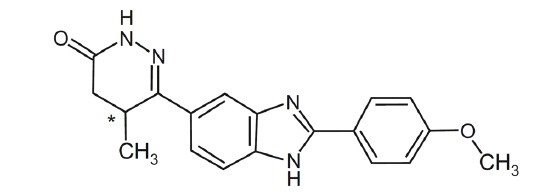
CaniBendan™ is supplied as oblong half-scored chewable tablets containing 1.25, 2.5, 5 or 10 mg pimobendan per tablet. Pimobendan, a benzimidazole-pyridazinone derivative, is a non-sympathomimetic, non-glycoside inotropic drug with vasodilatative properties. Pimobendan exerts a stimulatory myocardial effect by a dual mechanism of action consisting of an increase in calcium sensitivity of cardiac myofilaments and inhibition of phosphodiesterase (Type III). Pimobendan exhibits vasodilating activity by inhibiting phosphodiesterase III activity. The chemical name of pimobendan is 4,5-dihydro-6-[2-(4-methoxyphenyl)-1H-benzimidazole-5-yl]-5-methyl-, (±)-3(2H)-pyridazinone.
The structural formula of pimobendan is:
Clinical Pharmacology:
Pimobendan is oxidatively demethylated to a pharmacologically active metabolite which is then conjugated with sulfate or glucuronic acid and excreted mainly via feces. The mean extent of protein binding of pimobendan and the active metabolite in dog plasma is >90%. Following a single oral administration of 0.25 mg/kg pimobendan tablets the maximal mean (± 1 SD) plasma concentrations (C max ) of pimobendan and the active metabolite were 3.09 (0.76) ng/mL and 3.66 (1.21) ng/mL, respectively. Individual dog C max values for pimobendan and the active metabolite were observed 1 to 4 hours post-dose (mean: 2 and 3 hours, respectively). The total body clearance of pimobendan was approximately 90 mL/min/kg, and the terminal elimination half-lives of pimobendan and the active metabolite were approximately 0.5 hours and 2 hours, respectively.
Plasma levels of pimobendan and active metabolite were below quantifiable levels by 4 and 8 hours after oral administration, respectively. The steady-state volume of distribution of pimobendan is 2.6 L/kg indicating that the drug is readily distributed into tissues. Food decreased the bioavailability of an aqueous solution of pimobendan, but the effect of food on the absorption of pimobendan from pimobendan tablets is unknown.
In normal dogs instrumented with left ventricular (LV) pressure transducers, pimobendan increased LV dP/dt max (a measure of contractility of the heart) in a dose dependent manner between 0.1 and 0.5 mg/kg orally. The effect was still present 8 hours after dosing. There was a delay between peak blood levels of pimobendan and active metabolite and the maximum physiologic response (peak LV dP/dt max ). Blood levels of pimobendan and active metabolite began to drop before maximum contractility was seen. Repeated oral administration of pimobendan did not result in evidence of tachyphylaxis (decreased positive inotropic effect) or drug accumulation (increased positive inotropic effect). Laboratory studies indicate that the positive inotropic effect of pimobendan may be attenuated by the concurrent use of a β-adrenergic blocker or a calcium channel blocker.
How Supplied:
CaniBendan™ (Pimobendan Chewable Tablets): Available as 1.25, 2.5, 5 and 10 mg oblong half-scored chewable tablets - 50 tablets per bottle.
NDC 86136-159-36 - 1.25 mg - 50 tablets NDC 86136-160-36 - 2.5 mg - 50 tablets NDC 86136-161-36 - 5 mg - 50 tablets NDC 86136-162-36 - 10 mg - 50 tablets
Approved by FDA under ANADA # 200-728
