Get your patient on Carprofen
Carprofen prescribing information

INDICATIONS
OstiFen ® is indicated for the relief of pain and inflammation associated with osteoarthritis and for the control of postoperative pain associated with soft tissue and orthopedic surgeries in dogs.
DOSAGE AND ADMINISTRATION
Carefully consider the potential benefits and risks of OstiFen ® and other treatment options before deciding to use OstiFen ® . Use the lowest effective dose for the shortest duration consistent with individual response. The recommended dosage for subcutaneous administration to dogs is 2 mg/lb (4.4 mg/kg) of body weight daily. The total daily dose may be administered as either 2 mg/lb of body weight once daily or divided and administered as 1 mg/lb (2.2 mg/kg) twice daily. For control of postoperative pain, administer approximately 2 hours before the procedure.
CONTRAINDICATIONS
OstiFen ® should not be used in dogs exhibiting previous hypersensitivity to carprofen.
ADVERSE REACTIONS
During investigational studies for the caplet formulation, no clinically significant adverse reactions were reported. Some clinical signs were observed during field studies (n=297) which were similar for carprofen- and placebo-treated dogs. Incidences of the following were observed in both groups:
vomiting (4%), diarrhea (4%), changes in appetite (3%), lethargy (1.4%), behavioral changes (1%), and constipation (0.3%). The product vehicle served as control. There were no serious adverse events reported during clinical field studies with once daily oral administration of 2 mg/lb. The following categories of abnormal health observations were reported. The product vehicle served as control.
Percentage of Dogs with Abnormal Health Observations Reported in Clinical Field Study (2 mg/lb once daily)
| Observation | Carprofen (n=129) | Placebo (n=132) |
| Inappetence | 1.6 | 1.5 |
| Vomiting | 3.1 | 3.8 |
| Diarrhea/Soft stool | 3.1 | 4.5 |
| Behavior change | 0.8 | 0.8 |
| Dermatitis | 0.8 | 0.8 |
| PU/PD | 0.8 | - |
| SAP increase | 7.8 | 8.3 |
| ALT increase | 5.4 | 4.5 |
| AST increase | 2.3 | 0.8 |
| BUN increase | 3.1 | 1.5 |
| Bilirubinuria | 16.3 | 12.1 |
| Ketonuria | 14.7 | 9.1 |
Clinical pathology parameters listed represent reports of increases from pre-treatment values; the use of clinical judgement is necessary to determine clinical relevance (refers also to table below).
There were no serious adverse events reported during clinical field studies for the injectable formulation. The following categories of abnormal health observations were reported. Saline served as placebo control.
Percentage of Dogs with Abnormal Health Observations Reported in Clinical Field Studies with the Injectable
| Observation• | Carprofen (n=168) | Placebo (n=163) |
| Vomiting | 10.1 | 9.2 |
| Diarrhea/soft stool | 2.4 | 3.7 |
| Dermatitis | 0.6 | 1.2 |
| Dysrhythmia | 0.6 | 0.6 |
| Swelling | 0 | 1.2 |
| Dehiscence | 1.2 | 0 |
| WBC increase | 13.7 | 6.7 |
• A single dog may have experienced more than one occurrence of an event.
DESCRIPTION
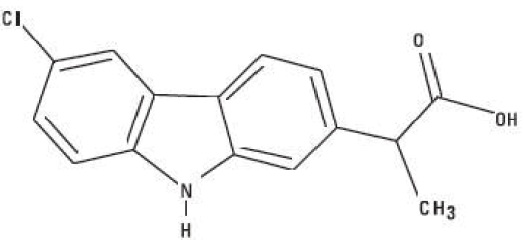
OstiFen ® Injectable is a sterile solution containing carprofen, a non-steroidal anti-inflammatory drug (NSAID) of the propionic acid class that includes ibuprofen, naproxen, and ketoprofen. Carprofen is the non-proprietary designation for a substituted carbazole, 6-chloro-α-methyl-9H-carbazole-2-acetic acid. The empirical formula is C 15 H 12 ClNO 2 and molecular weight 273.72.
The chemical structure of carprofen is:
Each mL of OstiFen ® Injectable contains 50.0 mg carprofen, 30.0 mg arginine, 88.5 mg glycocholic acid, 169.0 mg lecithin, 10.0 mg benzyl alcohol, 6.17 mg sodium hydroxide, with additional sodium hydroxide and hydrochloric acid as needed to adjust pH, and water for injection.
CLINICAL PHARMACOLOGY
Carprofen is a non-narcotic, non-steroidal anti-inflammatory agent with characteristic analgesic and antipyretic activity approximately equipotent to indomethacin in animal models. 1
The mechanism of action of carprofen, like that of other NSAIDs, is believed to be associated with the inhibition of cyclooxygenase activity. Two unique cyclooxygenases have been described in mammals. 2 The constitutive cyclooxygenase, COX-1, synthesizes prostaglandins necessary for normal gastrointestinal and renal function. The inducible cyclooxygenase, COX-2, generates prostaglandins involved in inflammation. Inhibition of COX-1 is thought to be associated with gastrointestinal and renal toxicity while inhibition of COX-2 provides anti-inflammatory activity. The specificity of a particular NSAID for COX-2 versus COX-1 may vary from species to species. 3 In an in vitro study using canine cell cultures, carprofen demonstrated selective inhibition of COX-2 versus COX-1. 4 Clinical relevance of these data has not been shown. Carprofen has also been shown to inhibit the release of several prostaglandins in two inflammatory cell systems: rat polymorphonuclear leukocytes (PMN) and human rheumatoid synovial cells, indicating inhibition of acute (PMN system) and chronic (synovial cell system) inflammatory reactions. 1
Several studies have demonstrated that carprofen has modulatory effects on both humoral and cellular immune responses. 5-9 Data also indicate that carprofen inhibits the production of osteoclast-activating factor (OAF), PGE 1 , and PGE 2 by its inhibitory effects on prostaglandin biosynthesis. 1
Based upon comparison with data obtained from intravenous administration, carprofen is rapidly and nearly completely absorbed (more than 90% bioavailable) when administered orally. 10 Peak blood plasma concentrations are achieved in 1-3 hours after oral administration of 1, 5, and 25 mg/kg to dogs. The mean terminal half-life of carprofen is approximately 8 hours (range 4.5-9.8 hours) after single oral doses varying from 1-35 mg/kg of body weight. After a 100 mg single intravenous bolus dose, the mean elimination half-life was approximately 11.7 hours in the dog. Carprofen is more than 99% bound to plasma protein and exhibits a very small volume of distribution. Comparison of a single 25 mg dose in Beagle dogs after subcutaneous and oral administration demonstrated that the dorsoscapular subcutaneous administration results in a slower rate of drug input (as reflected by mean peak observed concentrations) but comparable total drug absorption within a 12 hour dosing interval (as reflected by area under the curve from hours zero to 12 postdose). Carprofen is eliminated in the dog primarily by biotransformation in the liver followed by rapid excretion of the resulting metabolites (the ester glucuronide of carprofen and the ether glucuronides of 2 phenolic metabolites, 7-hydroxy carprofen and 8-hydroxy carprofen) in the feces (70-80%) and urine (10-20%). Some enterohepatic circulation of the drug is observed.
HOW SUPPLIED
OstiFen ® Injectable is supplied in 50-mL, amber, glass, sterile, multi-dose vials.
