Get your patient on Doxidyl (Deracoxib)
Doxidyl prescribing information

Indications and Usage:
Always provide “Information for Dog Owners” Sheet with prescription. Carefully consider the potential benefits and risk of DOXIDYL and other treatment options before deciding to use DOXIDYL. Use the lowest effective dose for the shortest duration consistent with individual response.
Osteoarthritis Pain and Inflammation:
DOXIDYL Chewable Tablets are indicated for the control of pain and inflammation associated with osteoarthritis in dogs.
Dosage and Administration:
Osteoarthritis Pain and Inflammation: 0.45 – 0.91 mg/lb/day (1 to 2 mg/kg/ day) as a single daily dose, as needed.
Dogs needing a dose of less than 12.5 mg can only be accurately dosed through use of the 12 mg tablet, which can be broken in half to provide 6 mg. Do not attempt to accurately dose smaller dogs through the use of breaking larger tablets. Inaccurate dosing may result in adverse drug events (see Adverse Reactions, Animal Safety, and Post-Approval Experience).
Postoperative Orthopedic Pain and Inflammation:
DOXIDYL Chewable Tablets are indicated for the control of postoperative pain and inflammation associated with orthopedic surgery in dogs.
Dosage and Administration:
Postoperative Orthopedic Pain and Inflammation: 1.4 – 1.8 mg/lb/day (3 to 4 mg/kg/day) as a single daily dose, as needed, not to exceed 7 days of administration.
Dogs needing a dose of less than 12.5 mg can only be accurately dosed through use of the 12 mg tablet, which can be broken in half to provide 6 mg. Do not attempt to accurately dose smaller dogs through the use of breaking larger tablets. Inaccurate dosing may result in adverse drug events (see Adverse Reactions, Animal Safety, and Post-Approval Experience).
Postoperative Dental Pain and Inflammation:
DOXIDYL Chewable Tablets are indicated for the control of postoperative pain and inflammation associated with dental surgery in dogs.
Dosage and Administration:
Postoperative Dental Pain and Inflammation: 0.45 – 0.91 mg/lb/day (1 to 2 mg/kg/day) as a single daily dose, for 3 days. The first dose should be given approximately 1 hour prior to dental surgery and subsequent doses should be given daily for up to two additional treatments.
Dogs needing a dose of less than 12.5 mg can only be accurately dosed through use of the 12 mg tablet, which can be broken in half to provide 6 mg. Do not attempt to accurately dose smaller dogs through the use of breaking larger tablets. Inaccurate dosing may result in adverse drug events (see Adverse Reactions, Animal Safety, and Post-Approval Experience).
Since deracoxib chewable tablet bioavailability is greatest when taken with food, postprandial administration is preferable. However, deracoxib chewable tablets have been shown to be effective under both fed and fasted conditions; therefore, they may be administered in the fasted state if necessary. For postoperative orthopedic and dental pain, administer DOXIDYL tablets prior to the procedure. Tablets are scored and dosage should be calculated in half-tablet increments. In clinical practice it is recommended to adjust the individual patient dose while continuing to monitor the dog's status until a minimum effective dose has been reached.
Contraindications:
Dogs with known hypersensitivity to deracoxib should not receive DOXIDYL.
Adverse Reactions:
Deracoxib was well tolerated and the incidence of clinical adverse reactions was comparable in deracoxib and placebo-treated animals. A total of 209 dogs of 41 breeds, 1-14 years old, weighing 17-177 lbs were included in the field safety analysis. The following table shows the number of dogs displaying each adverse reaction.
Abnormal Health Findings in the Osteoarthritis Field Study 1 | ||
Clinical Observation | Deracoxib (deracoxib) tablets N = 105 | Placebo N = 104 |
Vomiting | 3 | 4 |
Diarrhea/soft stool | 3 | 2 |
Weight loss | 1 | 0 |
Abdominal pain (splinting) | 0 | 1 |
Seizure | 1 | 0 |
Lethargy | 0 | 1 |
Pyoderma/Dermatitis | 2 | 0 |
Unilateral conjunctivitis | 1 | 0 |
Scleral injection | 0 | 1 |
Hematuria/UTI | 1 | 0 |
Splenomegaly• | 1 | 0 |
Grade II murmur systolic | 1 | 0 |
1 Dogs may have experienced more than one adverse reaction during the study.
• This dog was less active and eating less on enrollment, with elevated WBC, amylase, and AST and died 1 month after exiting the study. The dog was withdrawn from the study on Day 17 with anorexia, lethargy and a suspicion of diarrhea. Follow-up laboratory analyses revealed hypoalbuminemia, hyperphosphatemia, elevated AST and decreased BUN. Follow-up treatment included other anti-inflammatories and antibiotics.
Complete blood count, serum chemistry, and buccal bleeding time analysis were conducted at the beginning and end of the trial. Mean values of all CBC and chemistry results for both deracoxib and placebo-treated dogs were within normal limits. There was no statistically significant difference in the buccal bleeding time between deracoxib and placebo-treated dogs before or after the study, and all results remained within normal limits (less than 5 minutes). The results of this field study demonstrate that deracoxib is safe and effective for the control of pain and inflammation associated with osteoarthritis in dogs.
During this trial, dogs were safely treated with a variety of commonly used medications, including antibiotics, anti-parasiticides, topical flea adulticides and thyroid supplements.
The results of this field study demonstrate that deracoxib tablets are well tolerated when administered at 1-2 mg/kg/day for up to 43 days for the control of pain and inflammation associated with osteoarthritis.
Postoperative Orthopedic Pain and Inflammation Field Study:
In this study, 207 dogs admitted to veterinary hospitals for repair of a cranial cruciate injury were randomly administered deracoxib tablets or a placebo. Drug administration started the evening before surgery and continued once daily for 6 days postoperatively. Effectiveness was evaluated in 119 dogs and safety was evaluated in 207 dogs. Statistically significant differences in favor of deracoxib tablets were found for lameness at walk and trot, and pain on palpation values at all post-surgical time points. The results of this field study demonstrate that deracoxib tablets, when administered daily for 7 days are effective for the control of postoperative pain and inflammation associated with orthopedic surgery.
Adverse Reactions:
A total of 207 dogs of forty-three (43) different breeds, 1-15 years old, weighing 7-141 lbs were included in the field safety analysis. The following table shows the number of dogs displaying each adverse reaction.
Abnormal Health Findings in T he Postoperative Orthopedic Pain Field Study 1 | ||
Clinical Observation | Deracoxib tablets N = 105 | Placebo N = 102 |
Vomiting | 11 | 6 |
Diarrhea | 6 | 7 |
Hematochezia | 4 | 0 |
Melena | 0 | 1 |
Anorexia | 0 | 4 |
Incision site lesion (drainage, oozing) | 11 | 6 |
Non-incision skin lesions (moist dermatitis, pyoderma) | 2 | 0 |
Otitis externa | 2 | 0 |
Positive joint culture | 1 | 0 |
Phlebitis | 1 | 0 |
Hematuria | 2 | 0 |
Conjunctivitis | 1 | 2 |
Splenomegaly | 1 | 0 |
Hepatomegaly | 1 | 0 |
Death | 0 | 1 |
1 Dogs may have experienced more than one adverse reaction during the study.
This table does not include one dog that was dosed at 16.92 mg/kg/day for the study duration. Beginning on the last day of treatment, this dog experienced vomiting, diarrhea, increased water intake and decreased appetite. Hematology and clinical chemistry values were unremarkable. The dog recovered uneventfully within 3 days of cessation of dosing.
Incisional drainage was most prevalent in dogs enrolled at a single study site. There were no statistically significant changes in the mean values for hepatic or renal clinical pathology indices between deracoxib tablet- and placebotreated dogs. Four deracoxib tablet-treated dogs and two placebo-treated dogs exhibited elevated bilirubin during the dosing phase. One deracoxib tablet-treated dog exhibited elevated ALT, BUN and total bilirubin and a single vomiting event. None of the changes in clinical pathology values were considered clinically significant.
The results of this clinical study demonstrate that deracoxib tablets, when administered daily for 7 days to control postoperative orthopedic pain and inflammation in dogs, are well tolerated.
Postoperative Dental Pain and Inflammation Field Study:
In this study, 62 dogs admitted to veterinary hospitals for dental extractions were randomly administered deracoxib tablets or a placebo. Drug administration started approximately 1 hour before surgery and continued once daily for 2 days postoperatively. Effectiveness was evaluated in 57 dogs and safety was evaluated in 62 dogs. There was a statistically significant reduction (p=0.0338) in the proportion of dogs that required rescue therapy to control post-surgical pain in the deracoxib treated group compared to the placebo control group. Pain assessors used a modification of the Glasgow Composite Pain Scale (mGCPS) to assess pain. 7 A dog was rescued if it scored ≥ 4 on the combined mGCPS variables of Posture/Activity, Demeanor, Response to Touch, and Vocalization, or if the investigator determined at any time that pain intervention was needed. The results of this field study demonstrate that deracoxib, when administered once daily for 3 days, is effective for the control of postoperative pain and inflammation associated with dental surgery.
Adverse Reactions:
A total of 62 male and female dogs of various breeds, 1.5-16 years old, were included in the field safety analysis. The following table shows the number of dogs displaying each adverse reaction. Digestive tract disorders (diarrhea and vomiting) and systemic disorders (abnormal clinical chemistry results) were the most frequently reported findings. There were no distinct breed, age, or sex predilections for adverse reactions that were reported. No dogs were withdrawn from the study due to the occurrence of an adverse reaction.
Abnormal Health Findings in the Dental Pain Field Study 1 | ||
Clinical Observation | DERAMAXX N = 31 | Placebo N = 31 |
Vomiting | 4 | 1 |
Diarrhea/soft stool | 3 | 1 |
Regurgitation | 0 | 2 |
Increased AST 2 | 3 | 0 |
Increased ALT 2 | 1 | 0 |
Hematuria | 1 | 0 |
Leukocytosis | 1 | 1 |
Neutrophilia | 1 | 1 |
Lameness | 1 | 0 |
Facial swelling | 0 | 1 |
Tachycardia | 0 | 1 |
1 Dogs may have experienced more than one adverse reaction during the study.
2 Included animals with results over 2x the high normal.
Post Approval Experience (Rev. 2010):
The following adverse events are based on post-approval adverse drug experience reporting. Not all adverse reactions are reported to FDA CVM. It is not always possible to reliably estimate the adverse event frequency or establish a causal relationship to product exposure using this data. The following adverse events are grouped by body system and are presented in decreasing order of reporting frequency.
Gastrointestinal: vomiting, diarrhea, hypoalbuminemia, melena, hematochezia, elevated amylase/lipase, hematemesis, abdominal pain, peritonitis, decreased or increased total protein and globulin, gastrointestinal perforation, gastrointestinal ulceration, hypersalivation.
General: anorexia, depression/lethargy, weight loss, weakness, fever, dehydration
Hepatic: elevated liver enzymes, hyperbilirubinemia, icterus, ascites, decreased BUN
Hematologic: anemia, leukocytosis, leukocytopenia, thrombocytopenia
Neurologic: seizures, ataxia, recumbency, trembling, confusion, collapse, hind limb paresis, nystagmus, proprioceptive disorder, vestibular signs
Behavioral: nervousness, hyperactivity, aggression, apprehension
Urologic: elevated BUN/creatinine, polydipsia, polyuria, hyper-phosphatemia, hematuria, low urine specific gravity, urinary incontinence, renal failure, urinary tract infection
Dermatologic: pruritus, erythema, urticaria, moist dermatitis, facial/muzzle edema, dermal ulceration/necrosis
Respiratory: panting, dyspnea, epistaxis, coughing
Cardiovascular: tachycardia, heart murmur, bradycardia, arrest
Sensory: Vestibular signs, glazed eyes, uveitis.
Ophthalmic: blindness, mydriasis, conjunctivitis, keratoconjunctivitis sicca, uveitis
In some cases, death has been reported as an outcome of the adverse events listed above.
To report suspected adverse drug events, contact Ceva Animal Health, LLC at 1-800-999-0297. For additional information about adverse drug experience reporting for animal drugs, contact FDA at 1-888-FDA-VETS or http://www.fda.gov/AnimalVeterinary/SafetyHealth .
For technical assistance, call Ceva Animal Health, LLC at 1-800-999-0297.
Description:
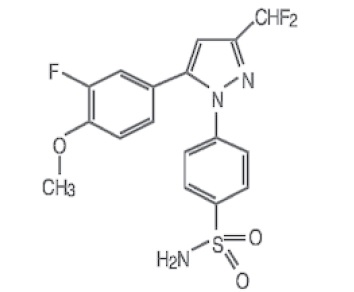
DOXIDYL ® (deracoxib) is a non-narcotic, non-steroidal anti-inflammatory drug (NSAID) of the coxib class. DOXIDYL tablets are round, biconvex, chewable tablets that contain deracoxib formulated with beefy flavoring. The molecular weight of deracoxib is 397.38. The empirical formula is C17-H14-F3-N3-O3-S. Deracoxib is 4-[3-(difluoromethyl)-5-(3-fluoro-4-methoxyphenyl)-1H-pyrazole-1yl] benzenesulfonamide, and can be termed a diaryl substituted pyrazole. The structural formula is:
Clinical Pharmacology
Mode of Action:
DOXIDYL tablets are a member of the coxib class of non-narcotic, non-steroidal, cyclooxygenase-inhibiting anti-inflammatory drugs for the control of postoperative pain and inflammation associated with orthopedic and dental surgery and for the control of pain and inflammation associated with osteoarthritis in dogs.
Data indicate that deracoxib inhibits the production of PGE1 and 6-keto PGF1 by its inhibitory effects on prostaglandin biosynthesis. 1 Deracoxib inhibited COX-2 mediated PGE2 production in LPS-stimulated human whole blood. 2
Cyclooxygenase-1 (COX-1) is the enzyme responsible for facilitating constitutive physiological processes (e.g., platelet aggregation, gastric mucosal protection, renal perfusion). 3 Cyclooxygenase-2 (COX-2) is responsible for the synthesis of inflammatory mediators. 4 Both COX isoforms are constitutively expressed in the canine kidney. 5 At doses of 2-4 mg/kg/day, deracoxib tablets do not inhibit COX-1 based on in vitro studies using cloned canine cyclooxygenase. 6 The clinical relevance of this in vitro data has not been shown.
Although the plasma terminal elimination half-life for deracoxib tablets is approximately 3 hours, a longer duration of clinical effectiveness is observed.
Summary pharmacokinetics of deracoxib tablets are listed in Table 1.
Table 1: Pharmacokinetics of Deracoxib | |
Parameter | Value |
Tmax a | 2 hours |
Oral Bioavailability (F) a | > 90% at 2 mg/kg |
Terminal elimination half-life b | 3 hours at 2-3 mg/kg 19 hours at 20 mg/kg |
Systemic Clearance b | ~ 5 ml/kg/min at 2 mg/kg ~1.7 ml/kg/min at 20 mg/kg |
Volume of Distribution c | ~ 1.5 L/kg |
Protein binding d | > 90% |
a Values obtained following a single 2.35 mg/kg dose
b Estimates following IV administration of deracoxib as an aqueous solution
c Based upon a dose of 2 mg/kg of deracoxib
d Based upon in vitro plasma concentrations of 0.1, 0.3, 1.0, 3.0, 10.0 μg/ml
Non-linear elimination kinetics are exhibited at doses above 8 mg/kg/day, at which competitive inhibition of constitutive COX-1 may occur.
Deracoxib is not excreted as parent drug in the urine. The major route of elimination of deracoxib is by hepatic biotransformation producing four major metabolites, two of which are characterized as products of oxidation and o-demethylation. The majority of deracoxib is excreted in feces as parent drug or metabolite.
Large intersubject variability was observed in drug metabolite profiles of urine and feces. No statistically significant differences between genders were observed.
How Supplied:
DOXIDYL tablets are available as 12 mg, 25 mg, 75 mg and 100 mg round, brownish, half-scored tablets in 7, 30, and 90 count bottles.
Manufactured for: Ceva Animal Health, LLC, Lenexa, KS 66215
