Get your patient on Enroquin Flavored (Enrofloxacin)
Enroquin Flavored prescribing information

DOSAGE AND ADMINISTRATION:
Dogs: Administer orally at a rate to provide 5-20 mg/kg (2.27 to 9.07 mg/lb) of body weight. Selection of a dose within the range should be based on clinical experience, the severity of disease, and susceptibility of the pathogen. Animals which receive doses in the upper-end of the dose range should be carefully monitored for clinical signs that may include inappetence, depression, and vomition. If dogs do not consume Enroquin Flavored Tablets willingly when offered by hand, then alternatively the tablet(s) may be offered in the food or hand- administered (pilled) as with other oral tablet medications.
| Weight of Dog | Once Daily Dosing Chart | |||
|---|---|---|---|---|
| 5.0 mg/kg | 10.0 mg/kg | 15.0 mg/kg | 20.0 mg/kg | |
| 9.1 kg (20 lb) | 2 × 22.7 mg tablets | 1 × 22.7 mg plus 1 × 68 mg tablets | 1 × 136 mg tablet | 1 × 136 mg plus 2 × 22.7 mg tablets |
| 27.2 kg (60 lb) | 1 × 136 mg tablets | 2 × 136 mg tablets | 3 × 136 mg tablets | 4 × 136 mg tablets |
All tablet sizes are double scored for accurate dosing.
Cats: Administer orally at 5 mg/kg (2.27 mg/lb) of bodyweight. The dose for dogs and cats may be administered either as a single daily dose or divided into two (2) equal daily doses administered at twelve (12) hour intervals. The dose should be continued for at least 2-3 days beyond cessation of clinical signs, to a maximum of 30 days. In cats, Enroquin Flavored Tablets should be pilled. After administration, watch the animal closely to be certain the entire dose has been consumed.
| Weight of Cat | Once Daily Dosing Chart (5 mg/kg/day) |
|---|---|
| 5 lb (2.27 kg) | 1/2 × 22.7 mg tablet |
| 10 lb (4.5 kg) | 1 × 22.7 mg tablet |
| 15 lb (6.8 kg) | 1 and 1/2 × 22.7 mg tablets or 1/2 × 68 mg tablet |
All tablet sizes are double scored for accurate dosing.
Dogs & Cats: The duration of treatment should be selected based on clinical evidence.
Generally, administration of Enroquin Flavored Tablets should continue for at least 2-3 days beyond cessation of clinical signs. For severe and/or complicated infections, more prolonged therapy, up to 30 days, may be required. If no improvement is seen within five days, the diagnosis should be re-evaluated and a different course of therapy considered.
The lower limit of the dose range in dogs and the daily dose for cats was based on efficacy studies in dogs and cats where enrofloxacin was administered at 2.5 mg/kg twice daily. Target animal safety and toxicology were used to establish the upper limit ofthe dose range for dogs and treatment duration for dogs and cats.
CONTRAINDICATIONS:
Enrofloxacin is contraindicated in dogs and cats known to be hypersensitive to quinolones.
Dogs: Based on the studies discussed under the section on Animal Safety Summary, the use of enrofloxacin is contraindicated in small and medium breeds of dogs during the rapid growth phase (between 2 and 8 months of age). The safe use of enrofloxacin has not been established in large and giant breeds during the rapid growth phase. Large breeds may be in this phase for up to one year of age and the giant breeds for up to 18 months. In clinical field trials utilizing a daily oral dose of 5.0 mg/kg, there were no reports of lameness or joint problems in any breed. However, controlled studies with histological examination of the articular cartilage have not been conducted in the large or giant breeds.
ADVERSE REACTIONS:
Dogs: Two of the 270 (0.7%) dogs treated with enrofloxacin at 5.0 mg/kg per day in the clinical field studies exhibited side effects, which were apparently drug-related. These two cases ofvomition were self-limiting.
Post-Approval Experience: The following adverse experiences, although rare, are based on voluntary post-approval adverse drug experience reporting. The categories of reactions are listed in decreasing order of frequency by body system.
Gastrointestinal: anorexia, diarrhea, vomiting, elevated liver enzymes
Neurologic: ataxia, seizures
Behavioral: depression, lethargy, nervousness
Cats: No drug-related side effects were reported in 124 cats treated with enrofloxacin at 5.0 mg/kg per day for 10 days in clinical field studies.
Post-Approval Experience: The following adverse experiences, although rare, are based on voluntary post-approval adverse drug experience reporting. The categories of reactions are listed in decreasing order of frequency by body system.
Ocular: Mydriasis, retinal degeneration (retinal atrophy, attenuated retinal vessels, and hyperreflective tapeta have been reported), loss of vision. Mydriasis may be an indication of impending or existing retinal changes.
Gastrointestinal: vomiting, anorexia, elevated liver enzymes, diarrhea
Neurologic: ataxia, seizures
Behavioral: depression, lethargy, vocalization, aggression
To report suspected adverse drug events, for technical assistance or to obtain a copy of the Safety Data Sheet, contact Dechra at (866) 933-2472. For additional information about adverse drug experience reporting for animal drugs, contact FDA at 1-888-FDA-VETS or http://www.fda.gov/reportanimalae.
DRUG INTERACTIONS:
Compounds that contain metal cations (e.g., aluminum, calcium, iron, magnesium) may reduce the absorption of some quinolone-class drugs from the intestinal tract. Concomitant therapy with other drugs that are metabolized in the liver may reduce the clearance rates of the quinoloneand the other drug.
Dogs: Enrofloxacin has been administered to dogs at a daily dosage rate of 10 mg/kg concurrently with a wide variety of other health products including anthelmintics (praziquantel, febantel, sodium disophenol), insecticides (fenthion, pyrethrins), heartworm preventatives (diethylcarbamazine) and other antibiotics (ampicillin, gentamicin sulfate, penicillin, dihydrostreptomycin). No incompatibilities with other drugs are known at this lime.
Cats: Enrofloxacin was administered at a daily dosage rate of 5 mg/kg concurrently with anthelmintics (praziquantel, febantel), an insecticide (propoxur) and another antibacterial (ampicillin). No incompatibilities with other drugs are known at this time.
DESCRIPTION:
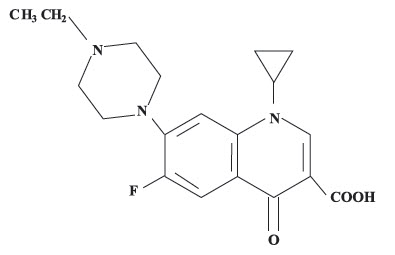
Enrofloxacin is a synthetic chemotherapeutic agent from the class of the quinolone carboxylic acid derivatives. It has antibacterial activity against a broad spectrum of Gram negative and Gram positive bacteria (See Tables I and II ). It is rapidly absorbed from the digestive tract, penetrating into all measured body tissues and fluids (See Table III ). Tablets are available in three sizes (22.7, 68.0 and 136.0 mg enrofloxacin).
CHEMICAL NOMENCLATURE AND STRUCTURAL FORMULA:
1-cyclopropyl-7-(4-ethyl-1-piperazinyl)-6-fluoro-1,4-dihydro-4-oxo-3-quinolinecarboxylic acid.
HOW SUPPLIED:
| NDC Number | Enroquin Flavored Tablets Tablet Size | Tablets/Bottle |
|---|---|---|
| 17033-303-10 | 22.7 mg | 100 Double Scored |
| 17033-303-50 | 22.7 mg | 500 Double Scored |
| 17033-304-05 | 68.0 mg | 50 Double Scored |
| 17033-304-25 | 68.0 mg | 250 Double Scored |
| 17033-305-05 | 136.0 mg | 50 Double Scored |
| 17033-305-20 | 136.0 mg | 200 Double Scored |
ACTIONS:
Microbiology:
Quinolone carboxylic acid derivatives are classified as DNA gyrase inhibitors. The mechanism of action of these compounds is very complex and not yet fully understood. The site of action is bacterial gyrase, a synthesis promoting enzyme. The effect on Escherichia coli is the inhibition of DNA synthesis through prevention of DNA supercoiling. Among other things, such compounds lead to the cessation of cell respiration and division. They may also interrupt bacterial membrane integrity. 1
Enrofloxacin is bactericidal, with activity against both Gram negative and Gram positive bacteria. The minimum inhibitory concentrations (MICs) were determined for a series of 39 isolates representing 9 genera of bacteria from natural infections in dogs and cats, selected principally because of resistance to one or more of the following antibiotics: ampicillin, cephalothin, colistin, chloramphenicol, erythromycin, gentamicin, kanamycin, penicillin, streptomycin, tetracycline, triple sulfa and sulfa/trimethoprim. The MIC values forenrofloxacin against these isolates are presented in Table I. Most strains of these organisms were found to be susceptible to enrofloxacin in vitro but the clinical significance has not been determined for some of the isolates.
The susceptibility of organisms to enrofloxacin should be determined using enrofloxacin 5 mcg disks. Specimens for susceptibility testing should be collected prior to the initiation ofenrofloxacin therapy.
| Organisms | Isolates | MIC Range (mcg/mL) |
|---|---|---|
| Bacteroides spp. | 2 | 2 |
| Bordetella bronchiseptica | 3 | 0.125-0.5 |
| Brucella canis | 2 | 0.125-0.25 |
| Clostridium perfringens | 1 | 0.5 |
| Escherichia coli | 5 Includes feline isolates. | ≤ 0.016-0.031 |
| Klebsiella spp. | 11 | 0.031-0.5 |
| Proteus mirabilis | 6 | 0.062-0.125 |
| Pseudomonas aeruginosa | 4 | 0.5-8 |
| Staphylococcus spp. | 5 | 0.125 |
The inhibitory activity on 120 isolates of seven canine urinary pathogens was also investigated and is listed in Table II.
| Organisms | Isolates | MIC Range (mcg/mL) |
|---|---|---|
| E. coli | 30 | 0.06-2.0 |
| P. mirabilis | 20 | 0.125-2.0 |
| K. pneumoniae | 20 | 0.06-0.5 |
| P. aeruginosa | 10 | 1.0-8.0 |
| Enterobacter spp. | 10 | 0.06-1.0 |
| Staph. (coag. +) | 20 | 0.125-0.5 |
| Strep. (alpha hemol.) | 10 | 0.5-8.0 |
Distribution in the Body: Enrofloxacin penetrates into all canine and feline tissues and body fluids. Concentrations of drug equal to or greater than the MIC for many pathogens (See Tables I , II and III ) are reached in most tissues by two hours after dosing at 2.5 mg/kg and are maintained for 8-12 hours after dosing. Particularly high levels ofenrofloxacin are found in urine.Asummary of the body fluid/tissue drug levels at 2 to 12 hours after dosing at 2.5 mg/kg is given in Table III.
| Single Oral Dose= 2.5 mg/kg (1.13 mg/lb) | ||||
|---|---|---|---|---|
| Post-treatment Enrofloxacin Levels | ||||
| Canine (n = 2) | Feline (n = 4) | |||
| Body Fluids (mcg/mL) | 2 Hr. | 8 Hr. | 2 Hr. | 12 Hr. |
| Bile | – | – | 2.13 | 1.97 |
| Cerebrospinal Fluid | – | – | 0.37 | 0.10 |
| Urine | 43.05 | 55.35 | 12.81 | 26.41 |
| Eye Fluids | 0.53 | 0.66 | 0.45 | 0.65 |
| Whole Blood | 1.01 | 0.36 | – | – |
| Plasma | 0.67 | 0.33 | – | – |
| Serum | – | – | 0.48 | 0.18 |
| Tissues (mcg/g) Hematopoietic System | ||||
| Liver | 3.02 | 1.36 | 1.84 | 0.37 |
| Spleen | 1.45 | 0.85 | 1.33 | 0.52 |
| Bone Marrow | 2.10 | 1.22 | 1.68 | 0.64 |
| Lymph Node | 1.32 | 0.91 | 0.49 | 0.21 |
| Urogenital System | ||||
| Kidney | 1.87 | 0.99 | 1.43 | 0.37 |
| Bladder Wall | 1.36 | 0.98 | 1.16 | 0.55 |
| Testes | 1.36 | 1.10 | 1.01 | 0.28 |
| Prostate | 1.36 | 2.20 | 1.88 | 0.55 |
| Ovaries | – | – | 0.78 | 0.56 |
| Uterine Wall | 1.59 | 0.29 | 0.81 | 1.05 |
| Gastrointestinal and Cardiopulmonary Systems | ||||
| Lung | 1.34 | 0.82 | 0.91 | 0.33 |
| Heart | 1.88 | 0.78 | 0.84 | 0.32 |
| Stomach | 3.24 | 2.16 | 3.26 | 0.27 |
| Small Intestine | 2.10 | 1.11 | 2.72 | 0.40 |
| Large Intestine | – | – | 0.94 | 1.10 |
| Other | ||||
| Fat | 0.52 | 0.40 | 0.24 | 0.11 |
| Skin | 0.66 | 0.48 | 0.46 | 0.17 |
| Muscle | 1.62 | 0.77 | 0.53 | 0.29 |
| Brain | 0.25 | 0.24 | 0.22 | 0.12 |
| Mammary Gland | 0.45 | 0.21 | 0.36 | 0.30 |
| Feces | 1.65 | 9.97 | 0.37 | 4.18 |
Pharmacokinetics:
In dogs, the absorption and elimination characteristics of the oral formulation are linear (plasma concentrations increase proportionally with dose) when enrofloxacin is administered at up to 11.5 mg/kg, twice daily. 2 Approximately 80% of the orally administered dose enters the systemic circulation unchanged. The eliminating organs, based on the drug's body clearance time, can readily remove the drug with no indication that the eliminating mechanisms are saturated. The primary route of excretion is via the urine. The absorption and elimination characteristics beyond this point are unknown. In cats, no oral absorption information is available at other than 2.5 mg/kg, administered orally as a single dose. Saturable absorption and/or elimination processes may occur at greater doses. When saturation of the absorption process occurs, the plasma concentration of the active moiety will be less than predicted, based on the concept of dose proportionality.
Following an oral dose in dogs of 2.5 mg/kg (1.13 mg/lb), enrofloxacin reached 50% of its maximum serum concentration in 15 minutes and peak serum level was reached in one hour. The elimination half-life in dogs is approximately 2½ - 3 hours at that dose, while in cats it is greater than 4 hours. In a study comparing dogs and cats, the peak concentration and the time to peak concentration were not different.
A graph indicating the mean serum levels following a dose of 2.5 mg/kg (1.13 mg/lb) in dogs (oral and intramuscular) and cats (oral) is shown in Figure 1.
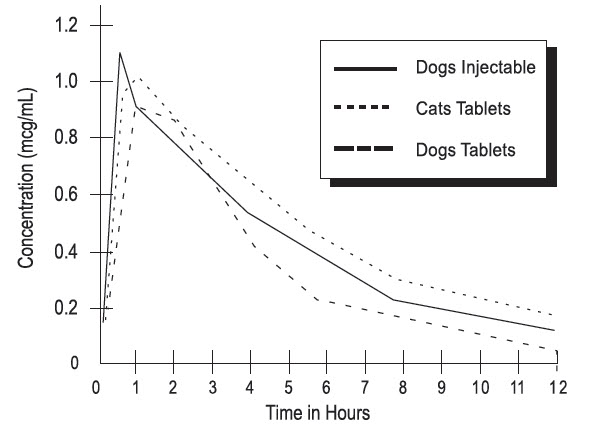
Figure 1 Serum Concentrations of Enrofloxacin Following a Single Oral or Intramuscular Dose at 2.5 mg/kg in Dogs and a Single Oral Dose at 2.5 mg/kg in Cats.
Breakpoint: Based on pharmacokinetic studies of enrofloxacin in dogs and cats after a single oral administration of 2.5 mg enrofloxacin/kg BW (i.e. half of the lowest-end single daily dose range for dogs and half the single daily dose for cats) and the data listed in Tables I and II, the following breakpoints are recommended for canine and feline isolates.
| Zone Diameter (mm) | MIC (μg/mL) | Interpretation |
|---|---|---|
| ≥ 21 | ≤ 0.5 | Susceptible (S) |
| 18 - 20 | 1 | Intermediate (I) |
| ≤ 17 | ≥ 2 | Resistant (R) |
A report of "Susceptible" indicates that the pathogen is likely to be inhibited by generally achievable plasma levels. A report of "Intermediate" is a technical buffer and isolates falling into this category should be retested. Alternatively the organism may be successfully treated if the infection is in a body site where drug is physiologically concentrated. A report of "Resistant" indicates that the achievable drug concentrations are unlikely to be inhibitory and other therapy should be selected.
Standardized procedures require the use of laboratory control organisms for both standardized disk diffusion assays and standardized dilution assays. The 5 µg enrofloxacin disk should give the following zone diameters and enrofloxacin powder should provide the following MIC values for reference strains.
| QC strain | MIC (μg/mL) | Zone Diameter (mm) |
|---|---|---|
| E. coli ATCC 25922 | 0.008 - 0.03 | 32 - 40 |
| P. aeruginosa ATCC 27853 | 1 - 4 | 15 - 19 |
| S. aureus ATCC 25923 | 27 - 31 | |
| S. aureus ATCC 29213 | 0.03 - 0.12 |