Get your patient on Methocarbamol And Aspirin - Methocarbamol And Aspirin tablet (Methocarbamol And Aspirin)
Methocarbamol And Aspirin - Methocarbamol And Aspirin tablet prescribing information

INDICATIONS AND USAGE
Methocarbamol and Aspirin tablets are indicated as an adjunct to rest, physical therapy and other measures for the relief of discomfort associated with acute, painful musculoskeletal conditions. The mode of action of methocarbamol has not been clearly identified but may be related to its sedative properties. Methocarbamol does not directly relax tense skeletal muscles in man.
DOSAGE AND ADMINISTRATION
Adults and children over 12 years of age: Two tablets four times daily. Three tablets four times daily may be used in severe conditions for one to three days in patient who are able to tolerate salicylates. These dosage recommendations provide respectively 3.2 and 4.8 grams of methocarbamol per day.
CONTRAINDICATIONS
Hypersensitivity to methocarbamol or aspirin.
ADVERSE REACTIONS
Adverse reactions reported coincident with the administration of methocarbamol include:
Body as a whole
Anaphylactic reaction, angioneurotic edema, fever, headache
Cardiovascular system
Bradycardia, flushing, hypotension, syncope, thrombophlebitis
Digestive system
Dyspepsia, jaundice (including cholestatic jaundice), nausea and vomiting
Hemic and lymphatic system
Leukopenia
Immune system
Hypersensitivity reactions
Nervous system
Amnesia, confusion, diplopia, dizziness or lightheadedness, drowsiness, insomnia, mild muscular
incoordination, nystagmus, sedation, seizures (including grand mal), vertigo
Skin and special senses
Blurred vision, conjunctivitis, nasal congestion, metallic taste, pruritus, rash, urticaria
Aspirin
Aspirin may increase the likelihood of hemorrhage due to its effect on the gastric mucosa and platelet function. Furthermore, aspirin has the potential to cause anaphylaxis in hypersensitive patients as well as angioedema especially in patients with chronic urticaria. Other adverse reactions due to aspirin use include anorexia, reversible hepatotoxicity, leukopenia, thrombocytopenia, purpura, decreased plasma iron concentration, and shortened erythrocyte survival time.
Adverse reactions that have been associated with the use of aspirin include: nausea and other gastrointestinal discomfort, gastritis, gastric erosion, vomiting, constipation, diarrhea, angio-edema, asthma, rash, pruritis, urticaria, exfoliative dermatitis, Stevens-Johnson Syndrome
(SJS), toxic epidermal necrolysis (TEN), and fixed drug eruption (FDE) (see WARNINGS ). Gastrointestinal discomfort may be minimized by taking Methocarbamol and Aspirin with food.
To report SUSPECTED ADVERSE REACTIONS, contact Jerome Stevens Pharmaceuticals Inc. at 1-844-686-1019 or FDA at 1-800-FDA-1088 or www.fda.gov/medwatch.
Drug Interactions
See WARNINGS and PRECAUTIONS for interaction with CNS drugs and alcohol.
Methocarbamol may inhibit the effect of pyridostigmine bromide. Therefore, methocarbamol should be used with caution in patients with myasthenia gravis receiving anticholinesterase agents.
Angiotensin Converting Enzyme (ACE) Inhibitors: The hyponatremic and hypotensive effects of ACE inhibitors may be diminished by the concomitant administration of aspirin due to its indirect effect on the renin-angiotensin conversion pathway.
Acetazolamide: Concurrent use of aspirin and acetazolamide can lead to high serum concentrations of acetazolamide (and toxicity) due to competition at the renal tubule for secretion.
Anticoagulant Therapy (Heparin and Warfarin): Patients on anticoagulation therapy are at increased risk for bleeding because of drug-drug interactions and the effect on platelets. Aspirin can displace warfarin from protein binding sites, leading to prolongation of both the prothrombin time and the bleeding time. Aspirin can increase the anticoagulant activity of heparin, increasing bleeding risk.
Anticonvulsants: Salicylate can displace protein-bound phenytoin and valproic acid, leading to a decrease in the total concentration of phenytoin and an increase in serum valproic acid levels.
Beta Blockers: The hypotensive effects of beta blockers may be diminished by the concomitant administration of aspirin due to inhibition of renal prostaglandins, leading to decreased renal blood flow, and salt and fluid retention.
Diuretics: The effectiveness of diuretics in patients with underlying renal or cardiovascular disease may be diminished by the concomitant administration of aspirin due to inhibition of renal prostaglandins, leading to decreased renal blood flow and salt and fluid retention.
Methotrexate: Aspirin may enhance the serious side and toxicity of methotrexate due to displacement from its plasma protein binding sites and/or reduced renal clearance.
Nonsteroidal Anti-inflammatory Drugs (NSAID's): The concurrent use of aspirin with other NSAID's should be avoided because this may increase bleeding or lead to decreased renal function. Aspirin may enhance the serious side effects and toxicity of ketorolac, due to displacement from its plasma protein binding sites and/or reduced renal clearance.
Oral Hypoglycemics Agents: Aspirin may increase the serum glucose-lowering action of insulin and sulfonylureas leading to hypoglycemia.
Uricosuric Agents: Salicylates antagonize the uricosuric action of probenecid or sulfinpyrazone.
DESCRIPTION
Each tablet, for oral administration contains:
Methocarbamol, USP 400 mg
Aspirin, USP 325 mg
Inactive Ingredients: Pregelatinized starch, povidone, croscarmellose sodium, magnesium stearate, microcrystalline cellulose, sodium starch glycolate, colloidal silicon dioxide, stearic acid.
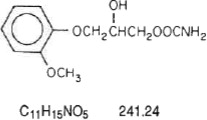
The chemical name of methocarbamol is 3-(2-meth-oxyphenoxy)-1,2-propanediol 1-carbamate and has the chemical formula C 11 H 15 NO 5 . Its molecular weight is 241.24. Methocarbamol is a white powder, sparingly soluble in water and chloroform, soluble in alcohol (only with heating) and propylene glycol, and insoluble in benzene and n-hexane. The structural formula is shown below.
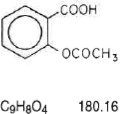
The aspirin component is 2-(acetyloxy)-, Benzoic acid, a white crystal, commonly tabular or needle-like, or white, crystalline powder. Is odorless or has a faint odor. Is stable in dry air; in moist air it gradually hydrolyzes to salicylic and acetic acids. Slightly soluble in water; freely soluble in alcohol; soluble in chloroform and in ether; sparingly soluble in absolute ether and is represented by the following structural formula:
CLINICAL PHARMACOLOGY
Methocarbamol and Aspirin provides a double approach to the management of discomforts associated with musculoskeletal disorders.
Methocarbamol
The mechanism of action of methocarbamol in humans has not been established, but may be due to general central nervous system depression. It has no direct action on the contractile mechanism of striated muscle, the motor end plate or the nerve fiber.
Aspirin
Aspirin (acetylsalicylic acid) works by inhibiting the body's production of prostaglandins, including prostaglandins involved in inflammation. Prostaglandins cause pain sensations by stimulating muscle contractions and dilating blood vessels throughout the body. In the CNS, aspirin works on the hypothalamus heat-regulating center to reduce fever, however, other mechanisms may be involved.
HOW SUPPLIED
Methocarbamol and Aspirin supplied as pink and white laminated, compressed tablets monogrammed JSP 490 in bottles of 100 (NDC 50564-490-01), 500 (NDC 50564-490-05).
Store at controlled room temperature 15° - 30°C (59° - 86°F). Protect from moisture.
Dispense in a tight container, as defined in the USP.
CAUTION: Federal law prohibits dispensing without prescription.
Manufactured by: Jerome Stevens Pharmaceuticals, Inc. Bohemia, New York 11716
REV. 07/24 MG #6317
