Get your patient on Petrem (Sevoflurane)
Petrem prescribing information

DESCRIPTION
Petrem ® (sevoflurane) is a volatile liquid, is a halogenated general inhalation anesthetic drug. Its chemical name is fluoromethyl 2,2,2-trifluoro-1-(trifluoromethyl) ethyl ether, and its structural formula is:
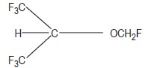
Sevoflurane Physical Constants are:
Molecular Weight 200.05
Boiling Point at 760 mm Hg 58.6°C
Specific Gravity at 20°C 1.520-1.525 g/mL
Vapor Pressure in mm Hg at 20°C 157
at 25°C 197
at 36°C 317
Distribution Partition Coefficients at 37°C:
Blood/Gas 0.63-0.69
Water/Gas 0.36
Olive Oil/Gas 47-54
Brain/Gas 1.15
Mean Component/Gas Partition Coefficients at 25°C for Polymers Used Commonly in Medical Applications:
Conductive rubber 14.0
Butyl rubber 7.7
Polyvinyl chloride 17.4
Polyethylene 1.3
Sevoflurane is nonflammable and nonexplosive as defined by the requirements of International Electrotechnical Commission 601-2-13.
Sevoflurane is a clear, colorless, stable liquid containing no additives or chemical stabilizers. Sevoflurane is nonpungent. It is miscible with ethanol, ether, chloroform and petroleum benzene, and it is slightly soluble in water. Sevoflurane is stable when stored under normal room lighting condition according to instructions.
CLINICAL PHARMACOLOGY
Sevoflurane is an inhalational anesthetic agent for induction and maintenance of general anesthesia. The Minimum Alveolar Concentration (MAC) of sevoflurane as determined in 18 dogs is 2.36%. 2 MAC is defined as that alveolar concentration at which 50% of healthy patients fail to respond to noxious stimuli. Multiples of MAC are used as a guide for surgical levels of anesthesia, which are typically 1.3 to 1.5 times the MAC value. Because of the low solubility of sevoflurane in blood (blood/gas partition coefficient at 37°C = 0.63-0.69), a minimal amount of sevoflurane is required to be dissolved in the blood before the alveolar partial pressure is in equilibrium with the arterial partial pressure. During sevoflurane induction, there is a rapid increase in alveolar concentration toward the inspired concentration.
Sevoflurane produces only modest increases in cerebral blood flow and metabolic rate, and has little or no ability to potentiate seizures. 3 Sevoflurane has a variable effect on heart rate, producing increases or decreases depending on experimental conditions. 4,5 Sevoflurane produces dose-dependent decreases in mean arterial pressure, cardiac output and myocardial contraction. 6 Among inhalation anesthetics, sevoflurane has low arrhythmogenic potential. 7
Sevoflurane is chemically stable. No discernible degradation occurs in the presence of strong acids or heat. Sevoflurane reacts through direct contact with CO 2 absorbents (soda lime and barium hydroxide lime) producing pentafluoroisopropenyl fluoromethyl ether (PIFE, C 4 H 2 F 6 0), also known as Compound A, and trace amounts of pentafluoromethoxy isopropyl fluoromethyl ether (PMFE, C 5 H 6 F 6 0), also known as Compound B.
Compound A:
The production of degradants in the anesthesia circuit results from the extraction of the acidic proton in the presence of a strong base (potassium hydroxide and/or NaOH) forming an alkene (Compound A) from sevoflurane. Compound A is produced when sevoflurane interacts with soda lime or barium hydroxide lime. Reaction with barium hydroxide lime results in a greater production of Compound A than does reaction with soda lime. Its concentration in a circle absorber system increases with increasing sevoflurane concentrations and with decreasing fresh gas flow rates. Sevoflurane degradation in soda lime has been shown to increase with temperature. Since the reaction of carbon dioxide with absorbents is exothermic, this temperature increase will be determined by the quantities of CO 2 absorbed, which in turn will depend on fresh gas flow in the anesthetic circle system, metabolic status of the patient and ventilation. Although Compound A is a dose-dependent nephrotoxin in rats, the mechanism of this renal toxicity is unknown. Two spontaneously breathing dogs under sevoflurane anesthesia showed increases in concentrations of Compound A as the oxygen flow rate was decreased at hourly intervals, from 500 mL/min (36 and 18 ppm Compound A) to 250 mL/min (43 and 31 ppm) to 50 mL/min (61 and 48 ppm). 8 Fluoride ion metabolite:
Sevoflurane is metabolized to hexafluoroisopropanol (HFIP) with release of inorganic fluoride and CO 2 . Fluoride ion concentrations are influenced by the duration of anesthesia and the concentration of sevoflurane. Once formed, HFIP is rapidly conjugated with glucuronic acid and eliminated as a urinary metabolite. No other metabolic pathways for sevoflurane have been identified. In humans, the fluoride ion half-life was prolonged in patients with renal impairment, but human clinical trials contained no reports of toxicity associated with elevated fluoride ion levels. In a study in which 4 dogs were exposed to 4% sevoflurane for 3 hours, maximum serum fluoride concentrations of 17.0-27.0 mcmole/L were observed after 3 hours of anesthesia. Serum fluoride fell quickly after anesthesia ended, and had returned to baseline by 24 hours post-anesthesia.
In a safety study, eight healthy dogs were exposed to sevoflurane for 3 hours/day, 5 days/week for 2 weeks (total 30 hours exposure) at a flow rate of 500 mL/min in a semi-closed, rebreathing system with soda lime. Renal toxicity was not observed in the study evaluation of clinical signs, hematology, serum chemistry, urinalysis, or gross or microscopic pathology.
HOW SUPPLIED
Petrem ® (sevoflurane) is packaged in 100 mL and 250 mL amber colored bottles. 100 mL NDC 66794-018-10 250 mL NDC 66794-018-25
