Get your patient on Prismasol bgk0/2.5- Calcium Chloride, Magnesium Chloride, Dextrose Anhydrous, Lactic Acid, Sodium Chloride, And Sodium Bicarbonate injection (Magnesium Chloride, Dextrose Anhydrous, Lactic Acid, Sodium Chloride, Sodium Bicarbonate, And Potassium Chloride)
Prismasol bgk0/2.5- Calcium Chloride, Magnesium Chloride, Dextrose Anhydrous, Lactic Acid, Sodium Chloride, And Sodium Bicarbonate injection prescribing information

INDICATIONS AND USAGE
PRISMASOL and PHOXILLUM solutions are indicated in pediatric and adult patients for use as a replacement solution in Continuous Renal Replacement Therapy (CRRT) to replace plasma volume removed by ultrafiltration and to correct electrolyte and acid-base imbalances. They may also be used in case of drug poisoning when CRRT is used to remove dialyzable substances.
DOSAGE AND ADMINISTRATION
Administration Instructions
Visually inspect PRISMASOL and PHOXILLUM for particulate matter and discoloration prior to administration.
Administration should only be under the direction of a physician competent in intensive care treatment including CRRT. Use only with extracorporeal dialysis equipment appropriate for CRRT.
The prepared solution is for single patient use only.
Aseptic technique should be used throughout administration to the patient.
Discard any unused solution.
Dosing Considerations
PRISMASOL replacement solutions contain 4 different combinations of active ingredients (7 different products with varying ingredient amounts). PHOXILLUM replacement solutions contain 2 different combinations of active ingredients (2 different products with varying ingredient amounts). PRISMASOL and PHOXILLUM are supplied in a two-compartment bag that must be mixed immediately prior to use [see Dosage and Administration (2.3) ]:
- Small compartment A (250 mL) containing an electrolyte solution, and
- Large compartment B (4750 mL) containing the buffer solution.
See Table 1 for the concentrations of the active ingredients (after mixing) in these 9 different replacement solutions (total volume is 5 Liters).
| Ca 2+ mEq/L | HCO 3 - mEq/L | K + mEq/L | Mg 2+ mEq/L | Na + mEq/L | HPO 4 2- mmol/L | Cl - mEq/L | Lactate mEq/L | Dextrose mg/dL | Osmolarity mOsm/L | |
|---|---|---|---|---|---|---|---|---|---|---|
| Ca 2+ = calcium, HCO 3 - = bicarbonate, K + = potassium, Mg 2+ = magnesium, Na + = sodium, HPO 4 2- = phosphate, Cl- = chloride; osmolarity is estimated | ||||||||||
PRISMASOL Replacement Solutions | ||||||||||
BGK0/2.5 | 2.5 | 32 | 0 | 1.5 | 140 | 0 | 109 | 3 | 100 | 292 |
BGK4/2.5 | 2.5 | 32 | 4 | 1.5 | 140 | 0 | 113 | 3 | 100 | 300 |
BGK2/3.5 | 3.5 | 32 | 2 | 1 | 140 | 0 | 111.5 | 3 | 100 | 296 |
BGK2/0 | 0 | 32 | 2 | 1 | 140 | 0 | 108 | 3 | 100 | 291 |
B22GK4/0 | 0 | 22 | 4 | 1.5 | 140 | 0 | 120.5 | 3 | 100 | 296 |
BGK4/0/1.2 | 0 | 32 | 4 | 1.2 | 140 | 0 | 110.2 | 3 | 100 | 295 |
BK0/0/1.2 | 0 | 32 | 0 | 1.2 | 140 | 0 | 106.2 | 3 | 0 | 282 |
PHOXILLUM Replacement Solutions | ||||||||||
BK4/2.5 | 2.5 | 32 | 4 | 1.5 | 140 | 1 | 114.5 | 0 | 0 | 294 |
B22K4/0 | 0 | 22 | 4 | 1.5 | 140 | 1 | 122 | 0 | 0 | 290 |
The mode of therapy, solute formulation, flow rates, and length of PRISMASOL and PHOXILLUM replacement therapy in CRRT should be established by a physician based on the patient’s clinical condition, blood concentration of phosphate and other electrolytes, acid-base and glucose balance. Administer either PRISMASOL or PHOXILLUM into the extracorporeal circuit:
- Before (pre-dilution) the hemofilter or hemodiafilter,
- After (post-dilution) the hemofilter or hemodiafilter, or
- Before and after the hemofilter or hemodiafilter.
Preparing the Solution
Use only if the overwrap is not damaged, all seals are intact, peel seal is not broken, and the solution is clear.
The solution may be warmed to 37°C/98.6°F prior to removing the overwrap to enhance patient comfort. However, only dry heat should be used. Solutions should not be heated in water or in a microwave oven. After heating, verify that the solution remains clear and contains no particulate matter.
The solutions are supplied in two different two-compartment bags made of polyolefin with a peel seal separating compartment A and B (see Figure 1 ).
Follow the instructions below when connecting the solution bags for correct use of the access ports.
Instructions for preparing solutions supplied in a two-compartment, polyolefin bag with a peel seal:
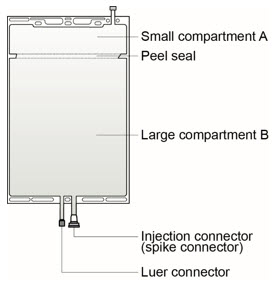
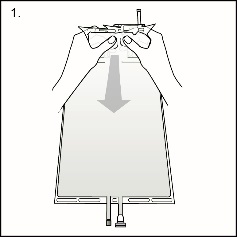
Figure 2 | Step 1 Immediately before use, remove the overwrap from the bag and mix the solutions in the two different compartments. After removing the overwrap, inspect the bag for leakage by pressing firmly on the bag. Discard the bag if any leakage is detected since sterility cannot be assured. As soon as the overwrap is removed, the reconstitution of compartments A and B should be done and the mixed solution should be used immediately. After removal of the overwrap, the solution is stable for 24 hours including the duration of the treatment. Hold the small compartment with both hands and squeeze it until an opening is created in the peel seal. (See Figure 2 beside) |
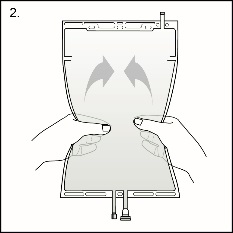
Figure 3 | Step 2 Squeeze with both hands on the large compartment until the peel seal between the two compartments is entirely open. Shake gently to mix. (See Figure 3 beside) The solution is now ready to use and the bag can be hung on the equipment. |
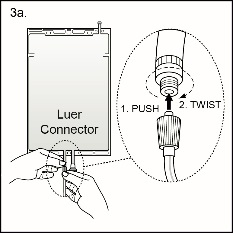
Figure 4a | Step 3 The replacement line may be connected to the bag through either of the luer connector or the injection connector (spike connector). Step 3a The luer connector is a needle-less and swabbable connector. Remove the cap with a twist and pull motion, and connect the male luer lock on the replacement line to the female luer receptor on the bag. (See Figure 4 a beside) Ensure that the connection is fully seated and tighten. The connector is now open. Verify that the fluid is flowing freely during use. When the replacement line is disconnected from the luer connector, the connector will close and the flow of the solution will stop. |
Figure 4b 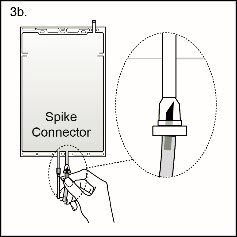 | Step 3b If the injection connector (spike connector) is used, first remove the snap-off cap. Then introduce the replacement line spike through the swabbable rubber septum of the bag connector. (See Figure 4 b beside) Ensure that the spike is fully inserted and verify that the fluid is flowing freely during use. |
Adding Drugs to the Solutions
After mixing, additional drugs may be added to the bag via injection connector (spike connector) in large compartment B. In general, administer drugs other than phosphate through a different access line.
When introducing drugs, use aseptic techniques and mix thoroughly prior to connecting the solution bag to the extracorporeal circuit.
Do not use if there is a color change and/or the appearance of precipitates, insoluble complexes or crystals after addition of medication.
Phosphate: Up to 1.2 mmol/L of phosphate can be added to the bag as potassium phosphate or sodium phosphate. The total potassium concentration of PRISMASOL solution should not exceed 4 mEq/L. Use sodium phosphate to add phosphate if the total potassium concentration in PRISMASOL solution is 4 mEq/L.
PHOXILLUM Solutions:
Phosphate: Phosphate up to 0.2 mmol/L may be added to the solution. Use sodium phosphate if adding phosphate to bag. The total phosphate concentration should not exceed 1.2 mmol/L.
DOSAGE FORMS AND STRENGTHS
See Table 1 for the concentrations of the active ingredients (after mixing) in these 9 different replacement solutions [see Dosage and Administration (2.2) ] .
USE IN SPECIFIC POPULATIONS
Pregnancy
Risk Summary
PRISMASOL and PHOXILLUM are pharmacologically inactive solutions. While there are no adequate and well controlled studies in pregnant women, appropriate administration of PRISMASOL and PHOXILLUM solutions with monitoring of fluid, electrolyte, acid-base and glucose balance, is not expected to cause fetal harm. Animal reproduction studies have not been conducted with PRISMASOL and PHOXILLUM solutions.
The estimated background risk of major birth defects and miscarriage for the indicated population are unknown. All pregnancies have a background risk of birth defect, loss or other adverse outcomes. In the U.S. general population, the estimated background risk of major birth defects and miscarriage in clinically recognized pregnancies is 2 to 4% and 15 to 20%, respectively.
Clinical Considerations
Maintenance of normal acid-base balance is important for fetal well-being.
Lactation
Risk Summary
The components of PRISMASOL and PHOXILLUM solutions are excreted in human milk. Appropriate administration of PRISMASOL and PHOXILLUM solutions with monitoring of fluid, electrolyte, acid-base and glucose balance, is not expected to harm a nursing infant.
Pediatric Use
Safety and effectiveness have been established based on published clinical data of CRRT replacement solutions with compositions similar to PRISMASOL and PHOXILLUM used in adults and two hemofiltration studies in pediatric patients, including a study of newborns to 17 years old.
Geriatric Use
The experience with PRISMASOL and PHOXILLUM solutions in geriatric patients has not identified novel concerns.
CONTRAINDICATIONS
PHOXILLUM and PRISMASOL replacement solutions are contraindicated in patients with known hypersensitivities to these products.
WARNINGS AND PRECAUTIONS
- Monitor hemodynamic status and fluid inputs and outputs, potassium, phosphorus, other electrolytes and acid-base balance. Abnormalities may be corrected by the use of appropriate formulations and dosage of PRISMASOL and PHOXILLUM solutions (5.1 )
- Treatment may affect glucose levels. Monitor blood glucose levels.
- Antidiabetic therapy adjustment or other corrective measures may be required during treatment (5.2 )
To report SUSPECTED ADVERSE REACTIONS, contact Vantive US Healthcare LLC at 1855-857-0003 or FDA at 1-800-FDA-1088 or www.fda.gov/medwatch
Electrolyte and Volume Abnormalities
PHOXILLUM and PRISMASOL solutions can affect electrolytes and volume and may result in hyperkalemia or hyperphosphatemia. Monitor hemodynamic status and fluid inputs and outputs, potassium, phosphorous, calcium, other electrolytes and acid-base balance throughout the procedure. Abnormalities may be corrected by changing the formulation of replacement solution and/or dialysate, supplementation, or adjusting flow rates appropriately [ see Dosage and Administration (2) ].
PHOXILLUM replacement solutions contain hydrogen phosphate, a weak acid that may increase the risk of metabolic acidosis .
Blood Glucose Abnormalities
The use of PRISMASOL and PHOXILLUM replacement solutions can affect blood glucose levels resulting in hypo- or hyper-glycemia depending upon the dextrose content of the replacement solution. Monitor blood glucose levels regularly. Patients may require initiation of or modification of antidiabetic therapy or other corrective measures during treatment.
ADVERSE REACTIONS
The following adverse reactions have been identified during postapproval use with these or other similar products and therefore may occur with use of PHOXILLUM or PRISMASOL. Because these reactions are reported voluntarily from a population of uncertain size, it is not always possible to reliably estimate their frequency or establish a causal relationship to drug exposure.
- Metabolic acidosis
- Hypotension
- Acid-base disorders
- Electrolyte imbalance including calcium ionized increased (reported in PRISMASOL solutions containing calcium), hyperphosphatemia, and hypophosphatemia
- Fluid imbalance
DRUG INTERACTIONS
As with the use of other replacement solutions, blood concentrations of dialyzable drugs may be reduced by CRRT due to their removal by the hemofilter or hemodiafilter. The blood concentrations of certain drugs may need to be monitored and appropriate therapy implemented to correct for removal during treatment.
Citrate
When used as an anticoagulant, citrate contributes to the overall buffer load and can reduce plasma calcium levels. Select the PRISMASOL/PHOXILLUM formulation(s) accordingly.
DESCRIPTION
PRISMASOL and PHOXILLUM solutions are clear, sterile, free of bacterial endotoxins and contain no bacteriostatic or antimicrobial agents. These solutions are used in Continuous Renal Replacement Therapies (CRRT) as a replacement solution in hemofiltration and hemodiafiltration. Depending on the product (see Table 2 ), the two compartments contain:
Calcium chloride, USP, is chemically designated calcium chloride dihydrate (CaCl 2 • 2H 2 O).
Magnesium chloride, USP, is chemically designated magnesium chloride hexahydrate (MgCl 2 • 6H 2 O).
Sodium chloride, USP, is chemically designated NaCl.
Potassium chloride, USP, is chemically designated KCl.
Sodium bicarbonate, USP, is chemically designated NaHCO 3 .
Dextrose, USP, is chemically designated D-Glucose anhydrous (C 6 H 12 O 6 ) or D-Glucose monohydrate (C 6 H 12 O 6 • H 2 O).
Lactic acid, USP, is chemically designated CH 3 CH(OH)COOH.
Dibasic sodium phosphate, USP, is chemically designated as disodium hydrogen phosphate, dihydrate (Na 2 HPO 4 • 2H 2 O)
| Compartment A (g/L) | Compartment B (g/L) | |||||||
|---|---|---|---|---|---|---|---|---|
| Calcium Chloride ∙ 2H 2 O | Magnesium Chloride ∙ 6H 2 O | Dextrose anhydrous (as monohydrate) | Lactic Acid | Sodium Chloride | Sodium bicarbonate | Potassium Chloride | Sodium Phosphate ∙ 2H 2 O | |
PRISMASOL SOLUTIONS | ||||||||
BGK 0/2.5 | 3.68 | 3.05 | 20 (22) | 5.40 | 6.46 | 3.09 | 0 | 0 |
BGK 4/2.5 | 3.68 | 3.05 | 20 (22) | 5.40 | 6.46 | 3.09 | 0.314 | 0 |
BGK 2/3.5 | 5.15 | 2.03 | 20 (22) | 5.40 | 6.46 | 3.09 | 0.157 | 0 |
BGK 2/0 | 0 | 2.03 | 20 (22) | 5.40 | 6.46 | 3.09 | 0.157 | 0 |
B22GK 4/0 | 0 | 3.05 | 20 (22) | 5.40 | 7.07 | 2.21 | 0.314 | 0 |
BK 0/0/1.2 | 0 | 2.44 | 0 (0) | 5.40 | 6.46 | 3.09 | 0 | 0 |
BGK 4/0/1.2 | 0 | 2.44 | 20 (22) | 5.40 | 6.46 | 3.09 | 0.314 | 0 |
PHOXILLUM SOLUTIONS | ||||||||
BK 4/2.5 | 3.68 | 3.05 | 0 (0) | 0 | 6.34 | 3.09 | 0.314 | 0.187 |
B22K 4/0 | 0 | 3.05 | 0 (0) | 0 | 6.95 | 2.21 | 0.314 | 0.187 |
The pH of the final solution is in the range of 7.0 to 8.5.
CLINICAL PHARMACOLOGY
Mechanism of Action
PRISMASOL and PHOXILLUM solutions are pharmacologically inactive. The electrolyte concentrations in the solutions are chosen to restore plasma levels to clinically desired concentrations or maintain plasma levels at the desired concentrations.
PRISMASOL and PHOXILLUM solutions are used as replacement solution to replace water and electrolytes removed during hemofiltration and hemodiafiltration. Bicarbonate (or precursor lactate) in the solution is used as an alkalinizing buffer to restore acid-base balance to a clinically desirable level.
Pharmacokinetics
The distribution of electrolytes, bicarbonate, and dextrose is determined by the patient's clinical condition, metabolic status, and residual renal function.
The elimination and replacement of water, electrolytes and buffer depend on the patient's electrolyte and acid-base balance, metabolic status, residual renal function and ongoing physiologic losses through intestinal, respiratory and cutaneous routes.
HOW SUPPLIED/STORAGE AND HANDLING
PRISMASOL and PHOXILLUM solutions are supplied in a two-compartment bag made of polyolefin. The 5000 mL bag is composed of a small compartment (250 mL) and a large compartment (4750 mL). The two compartments are separated by a peel seal.
The bag is overwrapped with a transparent overwrap. See Table 2 for the concentrations of the active ingredients in each compartment for each product [see Description (11) ].
Container | Fill Volume | NDC |
PRISMASOL Solutions | ||
PRISMASOL BGK0/2.5 | 5000 mL | 24571-108-06 |
PRISMASOL BGK4/2.5 | 5000 mL | 24571-105-06 |
PRISMASOL BGK2/3.5 | 5000 mL | 24571-103-06 |
PRISMASOL BGK2/0 | 5000 mL | 24571-102-06 |
PRISMASOL B22GK4/0 | 5000 mL | 24571-111-06 |
PRISMASOL BK0/0/1.2 | 5000 mL | 24571-113-06 |
PRISMASOL BGK4/0/1.2 | 5000 mL | 24571-114-06 |
PHOXILLUM Solutions | ||
PHOXILLUM BK4/2.5 | 5000 mL | 24571-116-06 |
PHOXILLUM B22K4/0 | 5000 mL | 24571-117-06 |
Not all formulations may be marketed.
Storage conditions
Store at 20°C to 25°C (68°F to 77°F); excursions permitted to 15ºC to 30ºC (59ºF to 86ºF). [See USP Controlled Room Temperature]
Do not freeze or expose to excessive heat. Do not use if precipitate has formed or if container seals have been damaged.
Manufactured for: Vantive US Healthcare LLC Deerfield, Illinois 60015
07-19-00-9693
Vantive, Phoxillum and PrismaSol are trademarks of Vantive Health LLC, or its affiliates
Mechanism of Action
PRISMASOL and PHOXILLUM solutions are pharmacologically inactive. The electrolyte concentrations in the solutions are chosen to restore plasma levels to clinically desired concentrations or maintain plasma levels at the desired concentrations.
PRISMASOL and PHOXILLUM solutions are used as replacement solution to replace water and electrolytes removed during hemofiltration and hemodiafiltration. Bicarbonate (or precursor lactate) in the solution is used as an alkalinizing buffer to restore acid-base balance to a clinically desirable level.
